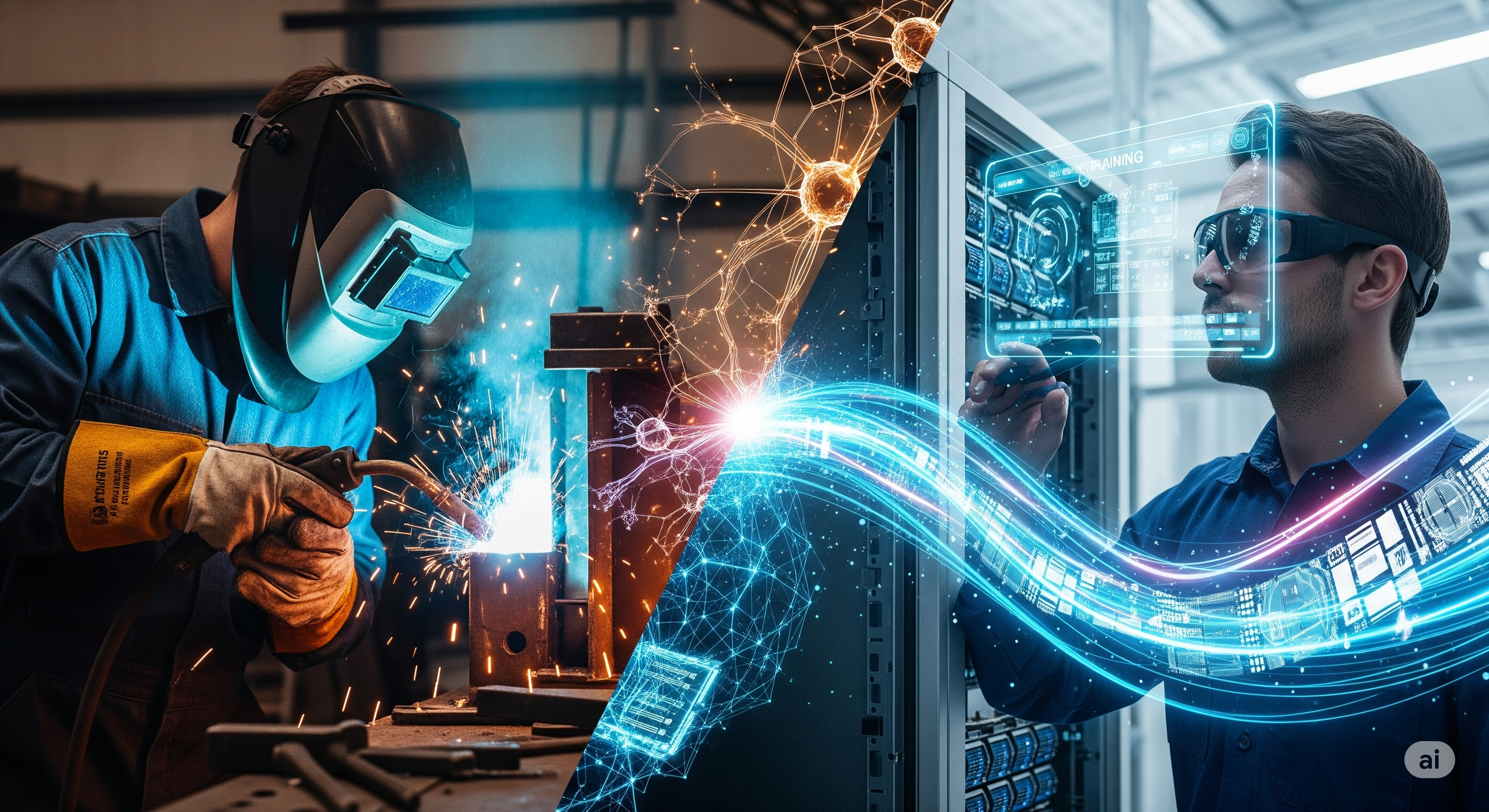
The $750B Hidden Opportunity: How AI's Infrastructure Boom Creates a Massive Market for Workforce Technology
The $750B Hidden Opportunity: How AI's Infrastructure Boom Creates a Massive Market for Workforce Technology
The AI revolution has a critical bottleneck—and it's not computing power.
While everyone obsesses over LLMs and neural networks, a $6.7 trillion infrastructure tsunami is creating an unprecedented crisis: we simply don't have enough skilled workers to build the physical backbone of the AI economy. This crisis represents the biggest opportunity in workforce technology since the internet.
The Numbers That Reveal the Crisis
The infrastructure gap is staggering:
- 6.7 trillion in AI infrastructure investment by 2030, with 5.2 trillion for data center capacity alone (McKinsey, 2024)
- Each hyperscale data center requires 1,500-3,000 skilled workers during peak construction
- The average electrician is 41 years old, with 40.2% of the workforce aged 45 or older
- 44% of welders are approaching retirement age—taking decades of expertise with them
- 300,000 new data center workers needed by 2025 (Uptime Institute)
But here's the critical math: 10,000 electricians leave the field annually, while only 7,000 enter. The gap is widening every day.
Why Traditional Training Systems Are Failing
The old apprenticeship model wasn't designed for exponential demand:
- Takes 4-5 years to produce a journeyman electrician
- Costs $250,000+ per fully trained worker
- Has a 50% dropout rate
- Can't scale to meet infrastructure demands
Meanwhile, 59% of Gen Z workers prefer learning from YouTube over traditional instruction. We have digital natives trapped in analog training systems, creating a perfect storm for technological disruption.
The Technology Revolution Already Happening
Smart companies are already proving that technology can compress decades of expertise into months:
Virtual Reality Training Systems
- 30-70% reduction in training costs compared to traditional methods
- Learners achieve competency 40% faster than classroom training
- 4x faster skill acquisition in controlled environments
Case Study: Ford reduced workplace injuries by 70% using AR/VR training systems. That's not just safety—it's millions saved in liability and insurance costs.
AI-Powered Skill Assessment
- Computer vision evaluates work quality with 99.9% accuracy
- Real-time feedback systems that mirror expert guidance
- Objective certification that eliminates human bias
Augmented Reality Field Training
Companies deploying AR-guided training report:
- 52% faster time to competency
- 20% reduction in workplace accidents
- Dramatic improvement in knowledge retention
The Market Opportunity Is Massive
This isn't a niche problem—it's a $750B+ market transformation:
- $750B+ global vocational training market (Grand View Research, 2024)
- Growing at 10% CAGR as infrastructure demands accelerate
- 300% ROI over 5 years for enterprise training technology deployments
The Perfect Storm of Catalysts
- Infrastructure Supercycle: $1T+ in data center construction alone
- Demographic Cliff: 40%+ of skilled workers retiring this decade
- Technology Maturation: VR/AR costs down 90% in five years
- Generational Shift: Digital-native workforce demanding modern tools
What This Means for Forward-Thinking Organizations
The companies that solve workforce training at scale won't just capture value—they'll enable the entire infrastructure economy to scale.
For Technology Companies
- Massive greenfield market with desperate buyers
- Sticky enterprise relationships once deployed
- Network effects as training data improves AI models
For Infrastructure Companies
- Solve the biggest constraint on growth
- Reduce training costs by 50-70%
- Improve safety outcomes and reduce liability
For Educational Institutions
- Modernize curriculum for digital-native students
- Improve job placement rates and student outcomes
- Create new revenue streams through corporate partnerships
The Technologies Reshaping Workforce Development
The most promising solutions combine multiple technologies:
Immersive Learning Platforms
- VR welding simulators with haptic feedback that eliminate material waste
- AR electrical training that overlays expert guidance on real installations
- AI tutoring systems that adapt to individual learning styles
Knowledge Capture Systems
- Digital twins of expert techniques before knowledge is lost
- Computer vision that analyzes and teaches proper form
- Voice-activated training assistants for hands-free learning
Certification Infrastructure
- Blockchain-verified credentials that travel with workers
- Real-time competency tracking for compliance
- AI-driven skill gap analysis for workforce planning
The Competitive Landscape Is Wide Open
Unlike consumer AI where big tech dominates, the industrial training market is fragmented and ripe for disruption:
- Traditional training companies lack technical expertise
- Tech companies don't understand industrial workflows
- Educational institutions move too slowly
- Government programs are underfunded and outdated
The opportunity: Companies that bridge technology and industry expertise can capture outsized market share.
Why This Wave Is Different
Previous workforce technology waves failed because:
- Technology wasn't mature enough
- Adoption barriers were too high
- ROI wasn't clear enough
Today's conditions are unprecedented:
- Desperate demand: Infrastructure companies can't find workers
- Proven ROI: 300%+ returns demonstrated in pilot programs
- Technology readiness: VR/AR/AI costs have plummeted
- Generational alignment: New workforce expects digital tools
The Path Forward
The companies that will win in this space understand:
- Industry-first approach: Technology serves workflow, not the reverse
- Partnership strategy: Work with unions, trade schools, and contractors
- Measurable outcomes: Focus on safety, speed, and certification
- Scalable platforms: Build for enterprise deployment, not just pilots
The Bigger Picture
This isn't just about training—it's about enabling the physical infrastructure that powers our digital future.
Without skilled workers, there are no data centers. Without data centers, there is no AI revolution.
The infrastructure is the platform. The workers are the bottleneck. Technology is the solution.
What's Next
The workforce technology revolution is just beginning. Early movers who understand both the technology possibilities and industry realities will capture the largest share of this massive market transformation.
The question isn't whether this market will explode—it's which companies will have the vision and execution to capture the value.
At Carboit, we're building technology solutions for the infrastructure economy. Our expertise spans AI, industrial workflows, and enterprise software—the perfect combination for this emerging opportunity.
Interested in exploring workforce technology solutions? [email protected]
Sources:
- McKinsey (2024): "The cost of compute: A $7 trillion race to scale data centers"
- Grand View Research (2024): "Technical and Vocational Education Market Report"
- U.S. Bureau of Labor Statistics (2024): "Occupational Outlook Handbook"
- Uptime Institute: "Global Data Center Survey 2024"
- Industry reports from PIXO VR, PwC, Klein Tools